Luther Ronzoni Vandross Jr. (20 April 1951 – 1 July 2005) was an American R&B and soul singer, songwriter, and record producer. Over the course of his career, he achieved eleven consecutive RIAA-certified platinum albums and sold more than 40 million records worldwide. He was included in Rolling Stone’s list of the 200 greatest singers of all time in 2023 and was named among the leading R&B artists by Billboard, while NPR listed him among its 50 Great Voices. He won eight Grammy Awards, including Song of the Year in 2004 for "Dance with My Father", and was inducted into both the National Rhythm and Blues Hall of Fame and the Grammy Hall of Fame.
Vandross began his career in the late 1960s performing at the Apollo Theater in New York City as part of a local ensemble that later appeared on "Sesame Street". He became a prominent backing vocalist, contributing to recordings by artists including Roberta Flack, Donny Hathaway, Todd Rundgren, Evelyn "Champagne" King, Judy Collins, Chaka Khan, Bette Midler, Diana Ross, David Bowie, Ben E. King, Stevie Wonder, Laura Branigan and Donna Summer. In 1980, he served as lead vocalist for the post-disco group Change on the album "The Glow of Love".
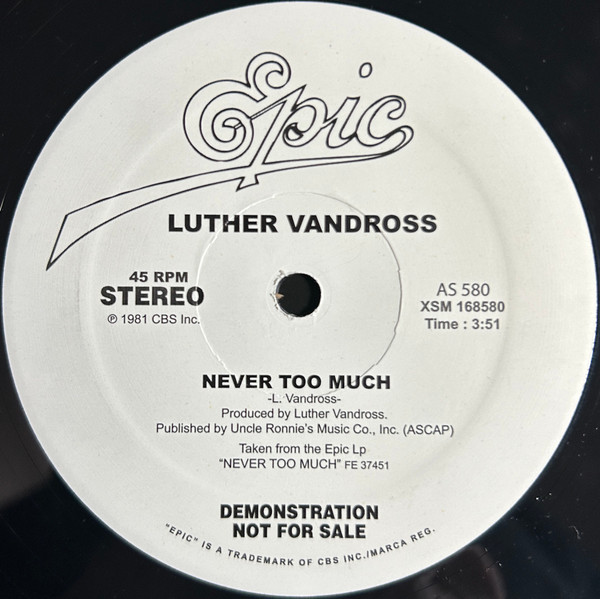
After leaving Change, Vandross signed with Epic Records and released his debut solo album "Never Too Much" in 1981. In 1982, he produced Aretha Franklin’s album "Jump to It", which reached the top of the Billboard R&B Albums chart. His notable songs include "Never Too Much", "Here and Now", "Any Love", "Power of Love/Love Power", "I Can Make It Better", and "For You to Love". He also recorded interpretations of earlier works such as "A House Is Not a Home", "Since I Lost My Baby", "Superstar", "I (Who Have Nothing)", and "Always and Forever".
Vandross collaborated on several duets, including "The Closer I Get to You" with Beyoncé, "Endless Love" with Mariah Carey, and "The Best Things in Life Are Free" with Janet Jackson. Following his death, the tribute album "So Amazing: An All-Star Tribute to Luther Vandross" was released. In 2024, Kendrick Lamar and SZA released the single "Luther", which samples Vandross’s recording of "If This World Were Mine", originally performed as a duet with Cheryl Lynn. In the same year, the documentary "Luther: Never Too Much" chronicled his life and career. In 2026, he was nominated for induction into the Rock and Roll Hall of Fame.
Vandross was born in the Kips Bay neighbourhood of Manhattan, New York City, and was raised on the Lower East Side. He was the youngest of four children. His father, an upholsterer and singer, died of diabetes when Vandross was eight years old. He later dedicated the song "Dance with My Father" to his memory. His family moved to the Bronx when he was nine. Vandross attended William Howard Taft High School, graduating in 1969, and briefly studied at Western Michigan University before leaving to pursue music full-time.
During his early career, Vandross performed with several vocal groups, including Shades of Jade and Listen My Brother, the latter appearing at the Harlem Cultural Festival in 1969 and on early episodes of "Sesame Street". In the 1970s, he established himself as a session and backing vocalist, working with numerous artists and contributing to projects such as David Bowie’s album "Young Americans". He also wrote "Everybody Rejoice/A Brand New Day" for the musical "The Wiz". In the late 1970s, he was a member of the group Luther, which released the albums "Luther" (1976) and "This Close to You" (1977), though neither achieved commercial success at the time.
In addition to recording work, Vandross performed commercial jingles for companies including NBC, Mountain Dew, Kentucky Fried Chicken, Burger King, and Juicy Fruit. He continued session work into the late 1970s, appearing on projects by Quincy Jones and others, and sang lead vocals on tracks such as "Hot Butterfly" with Bionic Boogie.
Vandross’s breakthrough came in 1980 with Change’s "The Glow of Love" and "Searching". He declined to continue with the group due to contractual disagreements and instead pursued a solo career. His debut album "Never Too Much" produced a number one R&B single with its title track and marked the beginning of a long collaboration with bassist Marcus Miller. Throughout the 1980s, he released a series of successful albums and singles, including "Stop to Love" and "There’s Nothing Better Than Love", a duet with Gregory Hines. He also produced albums for Aretha Franklin, including "Jump to It" and "Get It Right", and collaborated with Dionne Warwick on "How Many Times Can We Say Goodbye".
In 1989, the compilation album "The Best of Luther Vandross... The Best of Love" included "Here and Now", his first top ten pop single. In the 1990s, he continued his commercial success with albums such as "Power of Love" and collaborations including "The Best Things in Life Are Free" and a cover of "Endless Love". He also appeared in the film "The Meteor Man" and contributed to various television and recording projects. He received multiple Grammy Awards during this period, including Best Male R&B Vocal Performance for "Your Secret Love".
Vandross continued recording into the 2000s, releasing the album "Luther Vandross" in 2001, which included the singles "Take You Out" and "I’d Rather". In 2003, he released "Dance with My Father", which debuted at number one on the Billboard 200 and became the most commercially successful album of his career. The title track won the Grammy Award for Song of the Year.
In April 2003, Vandross suffered a stroke that affected his speech and mobility, though he later regained some abilities. He made a final public appearance in 2004. He died on 1 July 2005 at the age of 54 from a heart attack. His funeral was held in New York City, and he was buried in Paramus, New Jersey.
Studio albums
Never Too Much (1981)
Forever, for Always, for Love (1982)
Busy Body (1983)
The Night I Fell in Love (1985)
Give Me the Reason (1986)
Any Love (1988)
Power of Love (1991)
Never Let Me Go (1993)
Songs (1994)
This Is Christmas (1995)
Your Secret Love (1996)
I Know (1998)
Luther Vandross (2001)
Dance with My Father (2003)
Read more on Last.fm. User-contributed text is available under the Creative Commons By-SA License; additional terms may apply.