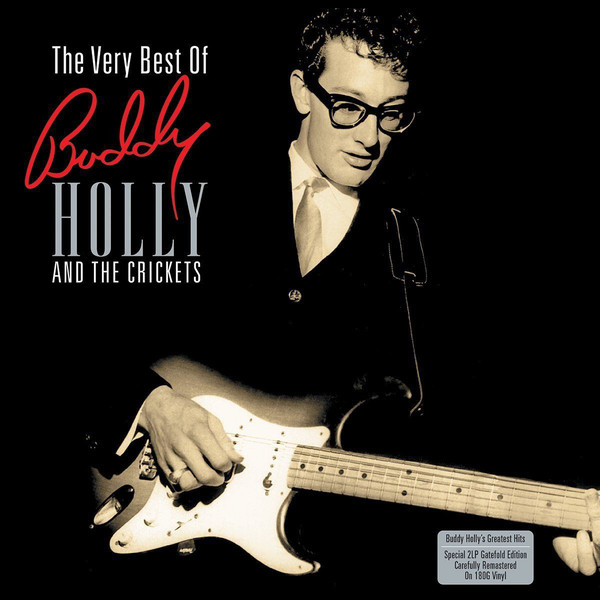
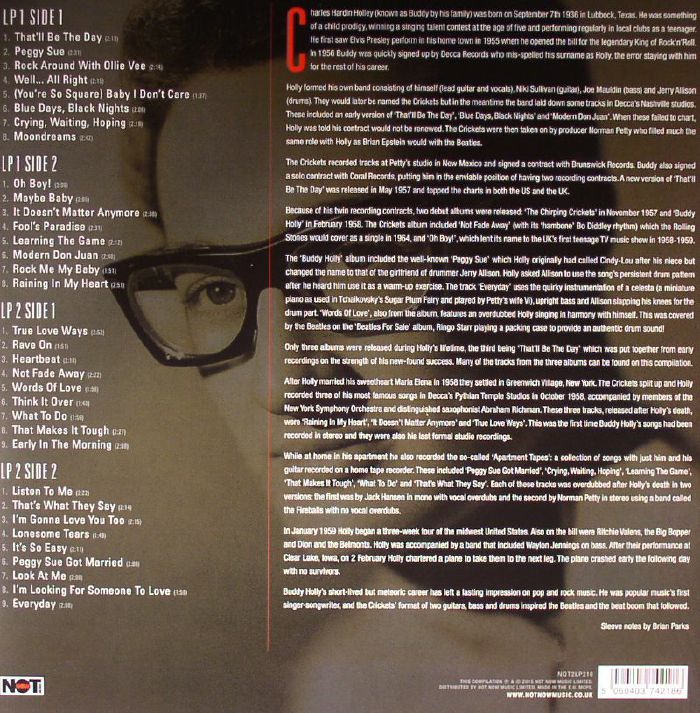
Charles Hardin Holley (September 7, 1936 – February 3, 1959), known professionally as Buddy Holly, was an American singer, songwriter, and musician who played an important role in the early development of rock and roll. He was born in Lubbock, Texas, during the Great Depression and grew up in a musical family, learning to play guitar and sing with his siblings.
Holly made his first appearance on local television in 1952, and the following year he formed the duo Buddy and Bob with his friend Bob Montgomery. In 1955, after opening a concert for Elvis Presley, Holly decided to pursue a professional music career. He performed with Presley on several occasions that year, and his band’s style began to shift from country and western toward rock and roll. Later in 1955, while opening for Bill Haley & His Comets, he was noticed by Nashville music scout Eddie Crandall, who helped him obtain a recording contract with Decca Records.
Holly’s recording sessions for Decca were produced by Owen Bradley, known for producing orchestrated country recordings for artists including Patsy Cline. Dissatisfied with Bradley’s approach and the level of control exercised in the studio, Holly later worked with producer Norman Petty in Clovis, New Mexico. There he recorded a demonstration of "That'll Be the Day" and other songs. Petty became the group’s manager and submitted the recording to Brunswick Records, which released it as a single credited to the Crickets, a name adopted by the band partly to avoid restrictions connected with Holly’s Decca contract. In September 1957, while the group was touring, "That'll Be the Day" reached number one on both the US and UK singles charts. It was followed by another major hit, "Peggy Sue", released in October 1957.
The album "The "Chirping" Crickets", released in November 1957, reached number five on the UK Albums Chart. Holly made his second appearance on the television programme "The Ed Sullivan Show" in January 1958 and soon afterwards toured Australia and the United Kingdom. In early 1959 he assembled a new band that included Waylon Jennings on bass, Tommy Allsup on guitar, and Carl Bunch on drums, and began a tour of the Midwestern United States. After a performance in Clear Lake, Iowa, Holly chartered a small airplane to travel to the next concert in Moorhead, Minnesota. Shortly after takeoff the aircraft crashed, killing Holly, Ritchie Valens, the Big Bopper, and pilot Roger Peterson. The event was later referred to by Don McLean as "The Day the Music Died" in the song "American Pie".
During his short career Holly wrote and recorded numerous songs and helped establish the rock band format of two guitars, bass, and drums. He influenced many later artists, including Bob Dylan, the Beatles, the Rolling Stones, Eric Clapton, the Hollies, Elvis Costello, and Elton John. In 1986 he was among the first artists inducted into the Rock and Roll Hall of Fame. In 2010 Rolling Stone magazine ranked him number 13 on its list of the 100 greatest artists.
Studio albums
Buddy Holly (1958)
That'll Be the Day (1958)
Read more on Last.fm. User-contributed text is available under the Creative Commons By-SA License; additional terms may apply.