GLOBAL GROOVE
Specialists in dance music and vinyl, over 60,000 in stock shipping worldwide daily.

FITZGERALD, ELLA / ARMSTRONG, LOUIS - [VL] ELLA & LOUIS

- NEW RELEASE

TITLE:
[VL] Ella & Louis
LABEL:
CATNO:
6785521
STYLE:
FORMAT:
Vinyl record
DESCRIPTION:
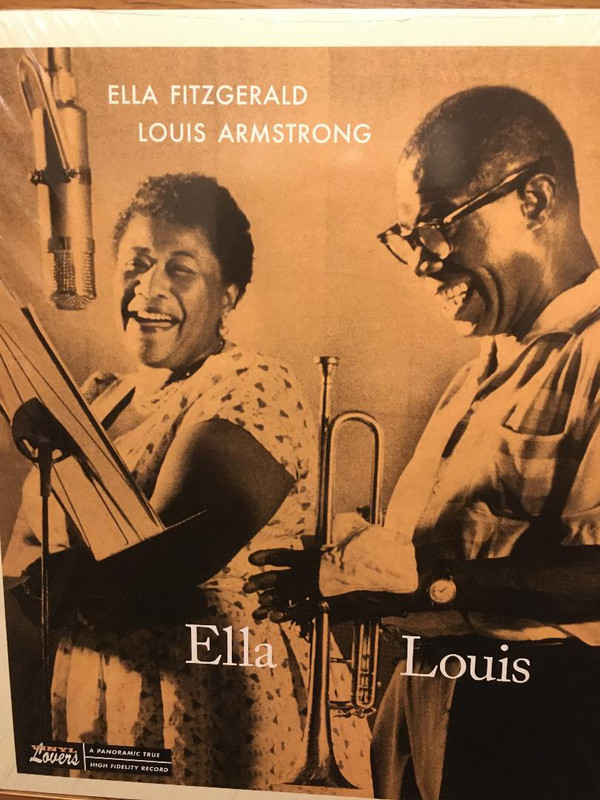
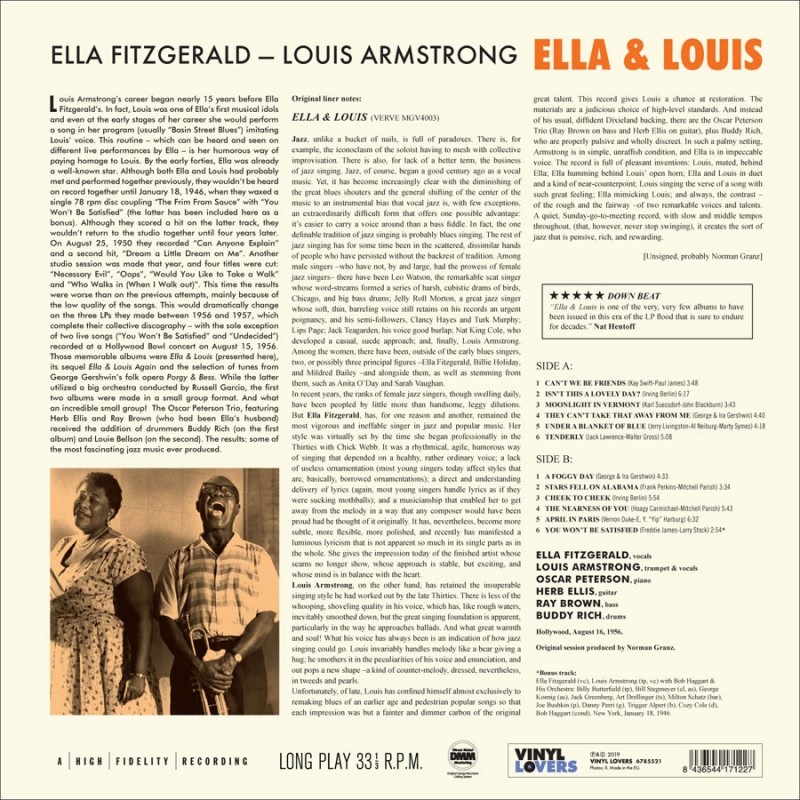
Louis Armstrong’s career began nearly 15 years before Ella Fitzgerald’s. In fact, Louis was one of Ella’s first musical idols and even at the early stages of her career she would perform a song in her program (usually “Basin Street Blues”) imitating Louis’ voice. This routine – which can be heard and seen on different live performances by Ella – is her humorous way of paying homage to Louis. By the early forties, Ella was already a well-known star. Although both Ella and Louis had probably met and performed together previously, they wouldn’t be heard on record together until January 18, 1946, when they waxed a single 78 rpm disc coupling “The Frim Fram Sauce” with “You Won’t Be Satisfied” (the latter has been included here as a bonus). Although they scored a hit on the latter track, they wouldn’t return to the studio together until four years later. On August 25, 1950 they recorded “Can Anyone Explain” and a second hit, “Dream a Little Dream on Me”. Another studio session was made that year, and four titles were cut: “Necessary Evil”, “Oops”, “Would You Like to Take a Walk” and “Who Walks in (When I Walk out)”. This time the results were worse than on the previous attempts, mainly because of the low quality of the songs. This would dramatically change on the three LPs they made between 1956 and 1957, which complete their collective discography – with the sole exception of two live songs (“You Won’t Be Satisfied” and “Undecided”) recorded at a Hollywood Bowl concert on August 15, 1956. Those memorable albums were Ella & Louis (presented here), its sequel Ella & Louis Again and the selection of tunes from George Gershwin’s folk opera Porgy & Bess. While the latter utilized a big orchestra conducted by Russell Garcia, the first two albums were made in a small group format. And what an incredible small group! The Oscar Peterson Trio, featuring Herb Ellis and Ray Brown (who had been Ella’s husband) received the addition of drummers Buddy Rich (on the first album) and Louie Bellson (on the second). The results: some of the most fascinating jazz music ever produced.

PRICE:
£16.99
RELEASED YEAR:
SLEEVE:
New
MEDIA:
New

BUY:
 
 
LISTEN:
Play       Cue Sample

TRACK LISTING:

Click to listen - add to playlist or download mp3 sample.

PLAY
 
CUE
MP3
a1
Can't We Be Friends
a2
Isn't This A Lovely Day
a3
Moonlight In Vermont
a4
They Can't Take That Away From Me
a5
Under A Blanket Of Blue
a6
Tenderly
b1
A Foggy Day
b2
Stars Fell On Alabama
b3
Cheek to Cheek
b4
The Nearness Of You
b5
April In Paris
b6
You Won't Be Satisfied

Last FM Information on Ella Fitzgerald

Please note the information is done on a artist keyword match and data is provided by LastFM.
Ella Jane Fitzgerald (April 25, 1917 – June 15, 1996) was an American singer, songwriter, and composer. She was known for her vocal range, precise diction, phrasing, timing, intonation, and improvisational ability, particularly in scat singing. Fitzgerald began her professional career with the Chick Webb Orchestra, performing across the United States and frequently at the Savoy Ballroom in Harlem. Her recording of the nursery rhyme "A-Tisket, A-Tasket" contributed to her and Webb's national recognition. After Webb's death in 1939, she led the orchestra for a period before beginning a solo career in 1942. Her early management was handled by Moe Gale, co-founder of the Savoy, and later by Norman Granz, who founded Verve Records to produce her recordings. With Verve, she released a number of notable albums, including interpretations of the Great American Songbook. Fitzgerald also appeared in films and on television throughout her career. She collaborated with musicians such as Louis Armstrong, Duke Ellington, and The Ink Spots, producing songs including "Dream a Little Dream of Me", "Cheek to Cheek", "Into Each Life Some Rain Must Fall", and "It Don't Mean a Thing (If It Ain't Got That Swing)". She performed publicly for nearly 60 years, giving her final performance in 1993. Fitzgerald died in 1996 at the age of 79. Her awards included 14 Grammy Awards, the National Medal of Arts, the NAACP's inaugural President's Award, and the Presidential Medal of Freedom. Studio albums Ella Sings Gershwin (1950) Songs in a Mellow Mood (1954) Songs from Pete Kelly's Blues (1955, with Peggy Lee) Ella Fitzgerald Sings the Cole Porter Song Book (1956) Ella and Louis (1956, with Louis Armstrong) Ella Fitzgerald Sings the Rodgers & Hart Song Book (1956) Ella and Louis Again (1957, with Louis Armstrong) Ella Fitzgerald Sings the Duke Ellington Song Book (1957, with Duke Ellington) Like Someone in Love (1957) One O'Clock Jump (1957, with Count Basie and Joe Williams) Porgy and Bess (1957) Ella Swings Lightly (1958) Ella Fitzgerald Sings the Irving Berlin Song Book (1958) Hello, Love (1959) Get Happy! (1959) Ella Fitzgerald Sings Sweet Songs for Swingers (1959) Ella Fitzgerald Sings the George and Ira Gershwin Song Book (1959) Ella Wishes You a Swinging Christmas (1960) Ella Fitzgerald Sings Songs from the Soundtrack of "Let No Man Write My Epitaph" (1960) Ella Fitzgerald Sings the Harold Arlen Song Book (1961) Clap Hands, Here Comes Charlie! (1961) Rhythm Is My Business (1962) Ella Swings Brightly with Nelson (1962) Ella Swings Gently with Nelson (1962) Ella Sings Broadway (1963) Ella Fitzgerald Sings the Jerome Kern Song Book (1963) Ella and Basie! (1963, with Count Basie) These Are the Blues (1963) Hello, Dolly! (1964) Ella Fitzgerald Sings the Johnny Mercer Song Book (1964) Ella at Duke's Place (1965, with Duke Ellington) Whisper Not (1966) Brighten the Corner (1967) Ella Fitzgerald's Christmas (1967) 30 by Ella (1968) Misty Blue (1968) Ella (1969) Things Ain't What They Used to Be (And You Better Believe It) (1970) Ella Loves Cole (1972) Take Love Easy (1973, with Joe Pass) Ella and Oscar (1975) Fitzgerald and Pass... Again (1976, with Joe Pass) Lady Time (1978) Fine and Mellow (1979) A Classy Pair (1979, with Count Basie) Ella Abraça Jobim (1981) The Best Is Yet to Come (1982) Speak Love (1983, with Joe Pass) Nice Work If You Can Get It (1983, with André Previn) Easy Living (1986, with Joe Pass) All That Jazz (1990) Read more on Last.fm. User-contributed text is available under the Creative Commons By-SA License; additional terms may apply.
Last FM Information on Louis Armstrong

Please note the information is done on a artist keyword match and data is provided by LastFM.
Louis Armstrong (August 4, 1901 - July 6, 1971) nicknamed Satchmo or Pops, was an American jazz trumpeter and singer from New Orleans, Louisiana. Coming to prominence in the 1920s as an inventive trumpet and cornet player, Armstrong was a foundational influence in jazz, shifting the focus of the music from collective improvisation to solo performance. With his instantly-recognizable gravelly voice, Armstrong was also an influential singer, demonstrating great dexterity as an improviser, bending the lyrics and melody of a song for expressive purposes. He was also skilled at scat singing (vocalizing using sounds and syllables instead of actual lyrics). Renowned for his charismatic stage presence and voice almost as much as for his trumpet-playing, Armstrong's influence extends well beyond jazz music, and by the end of his career in the 1960s, he was widely regarded as a profound influence on popular music in general. Armstrong was one of the first truly popular African-American entertainers to "cross over", whose skin-color was secondary to his music in an America that was severely racially divided. He rarely publicly politicized his race, often to the dismay of fellow African-Americans, but took a well-publicized stand for desegregation during the Little Rock Crisis. His artistry and personality allowed him socially acceptable access to the upper echelons of American society that were highly restricted for a black man. Armstrong was born and brought up in New Orleans, a culturally diverse town with a unique musical mix of creole, ragtime, marching bands, and blues. Although from an early age he was able to play music professionally, he didn't travel far from New Orleans until 1922, when he went to Chicago to join his mentor, King Oliver. Oliver's band played primitive jazz, a hotter style of ragtime, with looser rhythms and more improvisation, and Armstrong's role was mostly backing. Slow to promote himself, he was eventually persuaded by his wife Lil Hardin to leave Oliver, and In 1924 he went to New York to join the Fletcher Henderson Orchestra. At the time, there were a few other artists using the rhythmic innovations of the New Orleans style, but none did it with the energy and brilliance of Armstrong, and he quickly became a sensation among New York musicians. Back in Chicago in 1925, he made his first recordings with his own group, Louis Armstrong and his Hot Five, and these became not only popular hits but also models for the first generation of jazz musicians, trumpeters or otherwise. Other hits followed through the twenties and thirties, as well as troubles: crooked managers, lip injuries, mob entanglements, failed big-band ventures. As jazz styles changed, though, musical purists never lost any respect for him -- although they were sometimes irritated by his hammy onstage persona. Around the late forties, with the help of a good manager, Armstrong's business affairs finally stablilized, and he began to be seen as an elder statesman of American popular entertainment, appearing in Hollywood films, touring Asia and Europe, and dislodging The Beatles from the number-one position with Hello Dolly". Today many people may know him as a singer (a good one), but as Miles Davis said: “You can’t play nothing on modern trumpet that doesn’t come from him." The 62-year-old Armstrong became the oldest act to top the US charts when "Hello Dolly" reached #1 in 1964. Four years later Satchmo also became the oldest artist to record a UK #1, when "What a Wonderful World" hit the top spot. Read more on Last.fm. User-contributed text is available under the Creative Commons By-SA License; additional terms may apply.