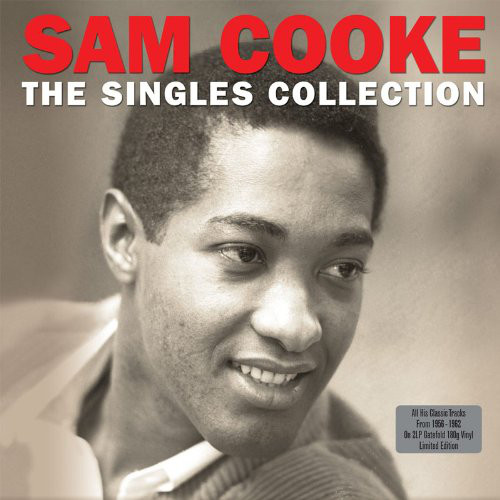
Samuel Cooke (né Cook; January 22, 1931 – December 11, 1964) was an American soul singer and songwriter. He is widely regarded as one of the most influential soul artists of all time and is often referred to as the "King of Soul" due to his distinctive vocal style, contributions to the development of the genre, and impact on popular music. During his thirteen-year career, Cooke released 29 singles that reached the Top 40 of the Billboard Hot 100 chart, as well as 20 singles that reached the Top 10 of Billboard's Black Singles chart. In 1964, he was shot and killed by the manager of a motel in Los Angeles. Following an inquest and investigation, his death was ruled a justifiable homicide. His family has since questioned the circumstances of his death. In 2015, Cooke was ranked number 28 on Billboard magazine's list of the "35 Greatest R&B Artists of All Time".
Sam Cooke was born Samuel Cook in Clarksdale, Mississippi, in 1931, later adding an "e" to his surname in 1958 as a personal and professional change. He was the fifth of eight children of Rev. Charles Cook, a Baptist minister, and Annie Mae Carroll. One of his younger brothers, L. C. Cooke (1932–2017), later became a member of the doo-wop group Johnny Keyes and the Magnificents. He was raised in a Baptist household.
In 1933, his family moved to Chicago, where he attended Doolittle Elementary School and Wendell Phillips Academy High School, which Nat King Cole had attended a few years earlier. He sang in his father's church choir and began performing with his siblings in a group called the Singing Children at the age of six. As a teenager, he became the lead singer of the Highway Q.C.'s after joining the group at 14. During this period, he became acquainted with fellow gospel singer Lou Rawls, who lived nearby and sang in a rival group.
In 1950, Cooke replaced gospel tenor R. H. Harris as the lead singer of the gospel group The Soul Stirrers, who were signed to Specialty Records. Their first recording under his leadership was "Jesus Gave Me Water" in 1950. The group also recorded songs including "Peace in the Valley", "How Far Am I from Canaan?", "Jesus Paid the Debt" and "One More River", among others, some of which he wrote. Cooke is credited with helping bring gospel music to a wider and younger audience.
Cooke began transitioning into pop music in the mid-1950s. His first pop single, "Lovable" (1956), was a remake of the gospel song "Wonderful" and was released under the pseudonym Dale Cook to avoid alienating his gospel audience. The release was not a major commercial success, but it demonstrated his potential as a crossover artist. He later signed with Keen Records, and in 1957 released "You Send Me", which became his first major hit. The single reached number one on both the Billboard R&B chart and the Billboard pop chart, significantly increasing his earnings and public profile.
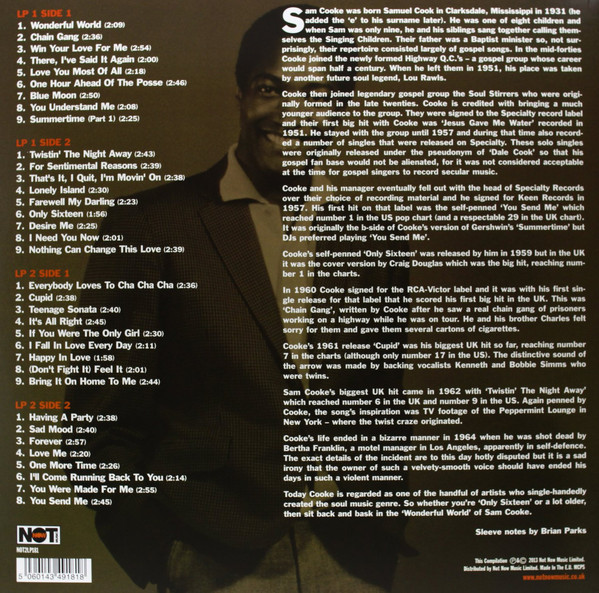
Between 1957 and 1964, Cooke achieved numerous hit singles, including "You Send Me", "Chain Gang", "Cupid", "Bring It On Home to Me", "Another Saturday Night", "Twistin' the Night Away", "Wonderful World" and "A Change Is Gonna Come". He also became involved in the business side of the music industry, establishing a record label and publishing companies. He was among the early Black performers in the United States to gain significant control over publishing and production aspects of his work, and he was also active in the civil rights movement.
In 1960, Cooke signed with RCA Victor and released "Chain Gang", which reached number two on the Billboard pop chart. He subsequently released several successful singles, including "Sad Mood", "Cupid", "Bring It On Home to Me" (featuring Lou Rawls on backing vocals), "Another Saturday Night" and "Twistin' the Night Away".
In 1961, he founded SAR Records with J. W. Alexander and his manager Roy Crain. The label signed acts including the Simms Twins, the Valentinos, Mel Carter and Johnnie Taylor. He also established a publishing and management company called Kags. Cooke primarily recorded singles, although he also released albums such as "Night Beat" (1963) and "Ain't That Good News" (1964), the latter including several singles.
Cooke later entered into a management and distribution arrangement involving Allen Klein, RCA Victor and a holding company named Tracey, Ltd, which was associated with ownership and distribution rights for his recordings. The arrangement included royalty payments and advances structured over several years.
Cooke was known for his tenor voice, which was widely described as rich, smooth and flexible. His vocal range and style allowed him to perform across gospel, R&B, pop and soul genres. He was noted for expressive phrasing, improvisation in live performances and the emotional delivery of songs such as "A Change Is Gonna Come". His singing style influenced numerous artists, including Otis Redding, James Brown, Rod Stewart, Tina Turner, Wilson Pickett, Mick Jagger, Al Green, Paul McCartney, Diana Ross, Marvin Gaye, Steve Perry and Stevie Wonder, among others.
Cooke was married twice. His first marriage was to singer and dancer Dolores Elizabeth Milligan Cooke, known professionally as Dee Dee Mohawk, in 1953. The couple divorced in 1958, and she died in a car accident in 1959. Cooke paid for her funeral expenses. In 1958, he married Barbara Campbell in Chicago. They had three children: Linda, Tracy and Vincent, the latter of whom died in 1963 after drowning in a swimming pool. He also had other children outside of marriage, including a son born following a paternity claim that was settled out of court.
In 1958, Cooke was involved in a car accident while travelling from St. Louis to Mississippi in which his chauffeur was killed and Cooke and two others were injured.
Cooke was involved in aspects of the civil rights movement and was associated with figures such as Muhammad Ali, Malcolm X and Jim Brown, who were also active in promoting racial equality.
On December 11, 1964, Cooke was shot and killed at the Hacienda Motel in Los Angeles. The motel manager stated that she shot him in self-defence following a confrontation. Police reported that Cooke had sustained a fatal gunshot wound to the chest. An inquest concluded that the killing was justifiable homicide, and the case was closed. Accounts of the incident differed between witnesses, including the motel manager and a woman who had been with Cooke earlier that evening. The circumstances of the event have remained disputed, and some of Cooke's family, friends and associates have questioned the official findings. No evidence supporting a criminal conspiracy has been established.
Full Wikipedia article: https://en.wikipedia.org/wiki/Sam_Cooke
Studio albums
Sam Cooke (1958)
Encore (1958)
Tribute to the Lady (1959)
Cooke's Tour (1960)
Hits of the 50's (1960)
Swing Low (1961)
My Kind of Blues (1961)
Twistin' the Night Away (1962)
Mr. Soul (1963)
Night Beat (1963)
Ain't That Good News (1964)
Read more on Last.fm. User-contributed text is available under the Creative Commons By-SA License; additional terms may apply.