GLOBAL GROOVE
Specialists in dance music and vinyl, over 60,000 in stock shipping worldwide daily.

CAN - DELAY 1968

- NEW RELEASE

Sorry, this item is currently unavailable.
ARTIST:
TITLE:
Delay 1968
LABEL:
CATNO:
XLSPOON12
STYLE:
FORMAT:
Vinyl record
DESCRIPTION:
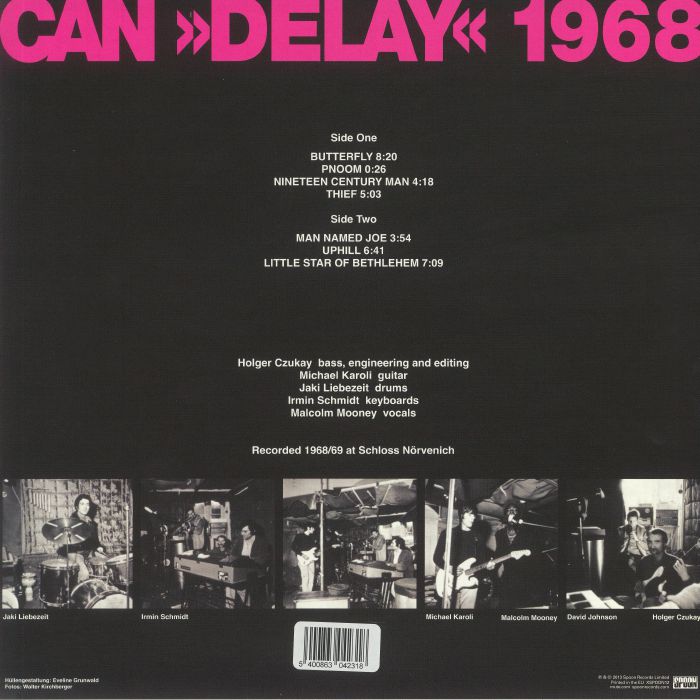
1981 Psych Rock LP Repressed on Translucent Pink Vinyl & Includes MPe Download Of The Album

Can was founded in 1968 by Irmin Schmidt, Holger Czukay, Michael Karoli and Jaki Liebezeit who formed a group which would utilise and transcend all boundaries of ethnic, electronic experimental and modern classical music.

This classic album of tracks recorded at the beginning of Can’s life, and features original vocalist Malcolm Mooney.

Thief is now a rejuvenated Can classic having been covered by Radiohead and since then discovered by a new generation of fans.

Can’s powerful influence has never diminished, and their indelible mark is apparent in the bands who freely acknowledge their importance - from Portishead, James Murphy, New Order, Factory Floor, Public Image Ltd, Mogwai, Kanye West and Radiohead - as well as across other disciplines such as visual art and literature.

"Can are impossible to classify and its impossible to ignore their seismic influence on so many diverse musical paths" Richard Hawley
"Can are the most revolutionary band ever" Stephen Morris (New Order)

PRICE:
£19.49
RELEASED YEAR:
SLEEVE:
New
MEDIA:
New

BUY:
 
 
LISTEN:
Play       Cue Sample

TRACK LISTING:

Click to listen - add to playlist or download mp3 sample.

PLAY
 
CUE
MP3
a1
Butterfly
a2
Pnoom
a3
Nineteen Century Man
a4
Thief
b1
Man Named Joe
b2
Uphill
b3
Little Star Of Bethlehem

Last FM Information on Can

Please note the information is done on a artist keyword match and data is provided by LastFM.
CAN was a German experimental rock band formed in Cologne in 1968. They split up in 1979 and were active again in 1986, 1988, 1991 and 1999. Members: ** Guitar, vocals, violin: Michael Karoli (1968–1979, 1986, 1988, 1991, 1999; died 2001) ** Drums, percussion, double bass, piano: Jaki Liebezeit (1968–1979, 1986, 1988, 1991, 1999; died 2017) ** Keyboards, vocals: Irmin Schmidt (1968–1979, 1986, 1988, 1991, 1999) ** Bass, sound engineer, electronics, vocals, French horn: Holger Czukay (1968–1977, 1986, 1988; died 2017) ** Reeds, winds, electronics, tape manipulation: David C. Johnson (1968; died 2021) ** Vocals: Malcolm Mooney (1968–1970, 1986, 1988, 1991) ** Vocals, percussion: Damo Suzuki (1970–1973; died 2024) ** Bass, vocals: Rosko Gee (1977–1979) ** Percussion, vocals: Rebop Kwaku Baah (1977–1979; died 1983) Additional collaborators: ** Vocals: Margarethe Juvan (1968) ** Vocals, percussion, flute: Manni Löhe (1968; died 1978) ** Lyrics: Duncan Fallowell (1974) ** Recording engineer: René Tinner (1973–1979, 1986, 1991) ** Tenor saxophone: Olaf Kübler (1975; died 2024) ** Vocals, guitar: Tim Hardin (November 1975; died 1980) ** Vocals: Thaiga Raj Raja Ratnam (January–March 1976) ** Vocals: Michael Cousins (March–April 1976) ** Lyrics, live sound mixing: Peter Gilmour (later 1970s) ** Recording engineer, bass (1999), sound processing and editing engineer (1999, 2003, 2011–2012): Jono Podmore Biography: The band was formed by Holger Czukay (bass, tape editing), Irmin Schmidt (keyboards), Michael Karoli (guitar), and Jaki Liebezeit (drums). They featured several vocalists, including American Malcolm Mooney (1968–70) and Japanese Damo Suzuki (1970–73). They have been hailed as pioneers of the German krautrock scene. The founding members of Can came from backgrounds in avant-garde music and jazz. They blended elements of psychedelic rock, space rock, funk, samba and musique concrète on influential albums such as Tago Mago (1971), Ege Bamyasi (1972) and Future Days (1973). Can also had commercial success with singles such as "Spoon" (1971) and "I Want More" (1976) reaching national singles charts. Their work has influenced rock, post-punk, indie rock, post-rock and ambient acts. 1960s Can, initially named the Inner Space, was formed in Cologne, Germany, in 1968 by Holger Czukay (bass), Irmin Schmidt (keyboard), Jaki Liebezeit (drums) and Michael Karoli (guitar). Czukay and Schmidt were from academic backgrounds, students of the composer Karlheinz Stockhausen, and were fascinated by the possibilities of rock and roll. By mid-1968, Can played their first show at an art opening at invitation of art collector Christoph Vohwinkel. The performance was taped, and extracts were released in January 1985 as a cassette Prehistoric Future. The live performance was recorded with Manni Löhe who played flute and percussion, with occasional vocals. In July 1968, Irmin's film industry connections delivered the group’s first commission. German public broadcaster ARD requested a track for the 1970 film Das Millionenspiel. The title track featured saxophone player Gerd Dudek and appeared on The Lost Tapes compilation. In late 1968, the Inner Space enlisted the American vocalist Malcolm Mooney. They recorded an album, Prepare to Meet Thy Pnoom, but could not find a recording company to release it. The Inner Space made the soundtrack pieces for 1969 films Agilok & Blubbo and Kamasutra: Vollendung der Liebe, making a brief appearance in the latter movie. "Man Named Joe", a track from Prepare to Meet Thy Pnoom, resurfaced on Kamasutra: Vollendung der Liebe. At Mooney's suggestion, the band changed their name to Can. Around the time of Johnson's departure, Mooney suggested the name for its positive meanings in various languages—for example, the English can ("be able to"); the Turkish can (pronounced [dʒan]), meaning "soul", "spirit", or "life"; and the Japanese 感 (kan; "feeling, emotion") and ちゃん (-chan, a suffix meaning "beloved"). Liebezeit later suggested the backronym definition "communism, anarchism, nihilism", after an English magazine claimed that this was the intended meaning. At invitation of Vohwinkel, they moved to Schloss Nörvenich, where they established a recording studio Inner Space. There, they recorded their debut album, Monster Movie (1969). It contained new versions of two songs previously recorded for Prepared to Meet Thy Pnoom, "Father Cannot Yell" and "Outside My Door". Monster Movie received acclaim. During one live performance, Mooney shouted "upstairs, downstairs" for three hours, even after Can had stopped playing. On his psychiatrist's advice, with this episode being diagnosed as a mental breakdown, he left Can and returned to the US at the end of 1969. He made his last recordings with Can that December. In 1970, Czukay and Liebezeit found a young Japanese expatriate, Damo Suzuki, busking outside a Munich café, and they invited him to join their performance that night at the Blow Up club. He subsequently replaced Mooney as their lead vocalist. In 1970, Can and Cat Stevens recorded music for the soundtrack to the film Deep End (1970); Can contributed the fourteen-and-a-half-minute psychedelic opus "Mother Sky", which was utilized throughout the film's Soho sequence. It was simultaneously released on Can's Soundtracks (1970) album alongside other music they had recorded for films. 1971–1973 The next few years saw Can release their most acclaimed works. While their earlier recordings were loosely based on traditional song structures, Can now developed a fluid improvisational style. The double album Tago Mago (1971) is often seen as groundbreaking, influential and deeply unconventional, based on intensely rhythmic jazz-inspired drumming, improvised guitar and keyboard solos, tape edits as composition, and Suzuki's idiosyncratic vocals. Czukay called the album "an attempt in achieving a mystery musical world from light to darkness and return". In 1971, the band composed the music for the three-part German-language television crime miniseries Das Messer ("The Knife"), directed by Rolf von Sydow. The track "Spoon" was used as the theme song; released as a single, it reached number 6 in the German singles chart. Tago Mago was followed in 1972 by Ege Bamyasi, a more accessible but still avant-garde record which featured "Spoon" and the follow-up single "Vitamin C". Czukay said, "We could achieve an excellent dry and ambient sound... [Ege Bamyasi] reflects the group being in a lighter mood." It was followed by Future Days in 1973, including the single "Moonshake" placed between long, drawn-out atmospheric songs. Czukay said, "'Bel Air' [the 20-minute track that takes up all of side two on the original Future Days LP] showed Can in a state of being an electric symphony group performing a peaceful though sometimes dramatic landscape painting", in a manner that has been retroactively compared to ambient music. Suzuki left soon after the recording of Future Days to marry his German girlfriend and become a Jehovah's Witness. Vocals were taken over by Karoli and Schmidt, but after Suzuki's departure fewer of Can's tracks featured vocals, as the band experimented with the ambient music it had begun with Future Days. 1974–1979 Soon Over Babaluma from 1974 continued in the atmospheric style of Future Days, but with some of the abrasive edge of Tago Mago and Ege Bamyasi returning. In 1975, Can signed with Virgin Records in the UK and EMI/Harvest in West Germany, appearing the same year on the BBC's Old Grey Whistle Test in a memorable performance of "Vernal Equinox" in which Schmidt played one keyboard section with a series of rapid karate chops. Shortly after the appearance, Schmidt suffered a broken leg which led to cancellation of the band's UK tour. Landed (1975) and Flow Motion (1976) saw Can moving toward a somewhat more conventional style as recording technology improved. The disco-influenced single "I Want More" from Flow Motion became their only hit record outside of West Germany. Co-written by live sound mixer Peter Gilmour, it reached No. 26 in the UK charts in October 1976, which prompted an appearance on Top of the Pops. In 1977 Can was joined by former Traffic bassist Rosko Gee and percussionist Rebop Kwaku Baah, both of whom also provided vocals; they appeared on the albums Saw Delight (1977), Out of Reach (1978) and Can (1979). During this period, Czukay was pushed to the fringes of the group's activity due to disagreements about the band's creative direction and his limited abilities on his instrument. Bass guitar was something Czukay had "taken up almost by default" and he readily admitted his limitations. After Gee joined, Czukay primarily made sounds using shortwave radios, Morse code keys, tape recorders and other sundry objects. He left Can in late 1977 and did not appear on the albums Out of Reach or Can, although he was involved with production work for the latter album. After the split and reunion After the split, all the former members were involved in musical projects, often as session musicians for other artists. Czukay recorded several ambient albums and collaborated with David Sylvian among others. Jaki Liebezeit played extensively with bassists Jah Wobble and Bill Laswell, with a drum ensemble called Drums off Chaos and in 2005 with Datenverarbeiter on the online album Givt. In 1986, Can briefly reformed with Mooney to record Rite Time (released in 1989). There was a further reunion in 1991 by Karoli, Liebezeit, Mooney and Schmidt to record a track for the Wim Wenders film Until the End of the World and in August 1999 by Karoli, Liebezeit and Schmidt with Jono Podmore to record a cover of "The Third Man Theme" for Grönland Records' compilation album Pop 2000. In 1999, the four core members of Can (Karoli, Liebezeit, Schmidt and Czukay) performed live at the same show, although playing separately with their current solo projects (Sofortkontakt, Club Off Chaos, Kumo and U-She respectively). Can have since been the subject of numerous compilations, live albums and samples. In 2004, the band began a series of Super Audio CD remasters of its back catalog, which were finished in 2006. Karoli died of cancer on 17 November 2001. Liebezeit died of pneumonia on 22 January 2017. Czukay died of natural causes on 5 September 2017. Suzuki died of cancer on 9 February 2024. Discography: Albums: 1969: Monster Movie 1971: Tago Mago 1972: Ege Bamyasi 1973: Future Days 1974: Soon Over Babaluma 1975: Landed 1976: Flow Motion 1977: Saw Delight 1978: Out of Reach 1979: Can 1989: Rite Time Studio compilation albums: 1970: Soundtracks 1974: Limited Edition 1976: Unlimited Edition 1981: Delay 1968 1995: The Peel Sessions 2009: Agilok & Blubbo 2009: Kamasutra: Vollendung der Liebe 2012: The Lost Tapes 2017: The Singles Live albums: 1999: Can Live Music (Live 1971–1977) 2021: Live in Stuttgart 1975 2021: Live in Brighton 1975 2022: Live in Cuxhaven 1976 2024: Live in Paris 1973 2024: Live in Aston 1977 2024: Live in Keele 1977 Other releases: 1982: Onlyou 1985: Prehistoric Future 1997: Sacrilege Read more on Last.fm. User-contributed text is available under the Creative Commons By-SA License; additional terms may apply.


Recently Viewed:

Below is a list of items you have viewed: